
booksmusicfilmstv.com: Home Books Music Films TV Peace & Freedom Press
booksmusicfilmstv.com Poetry Index - links to poetry books for sale, poetry news, poetry reviews, classic poems, emerging poets, etc.
An Introduction To Patrick Kavanagh (1904-1967)
By Mary Buckley-Clarke
The Poetry of Mary Buckley-Clarke
The poet Patrick Kavanagh was born in Inniskeen, Co. Monaghan on 21st October 1904, a small rural town-land in the north-east of Ireland, 8 miles from Dundalk and 6 miles from the town of Carrigmacross.
He was the fourth of nine children; large families were the norm in those days. Poverty was widespread, most people eked out a living as best they could on small, barely viable holdings.
The Kavanaghs were fortunate in that Patrick's father was a very literate man, he had also been apprenticed to a cobbler and, having a craft, could support his family better than most. His mother, Brigid, was an astute, hard working woman, determined to improve the family's fortunes any way she could. Both parents were hard working and frugal in their life-style, saving money to eventually buy enough land to be considered small farmers. The children grew up in a secure home, rich in social interaction. The family business of shoemaking was carried on in the kitchen, thus ensuring a constant flow of people to the house. Many had stories to tell, the children's lives were filled with fairy tales and ghost stories; music played a large part in family life. Patrick's father, James, had a keen ear and played the melodion with great skill. It featured in the poet's early work, his pleasure vividly expressed in A Christmas Childhood.
My father played the melodion
Outside at our gate;
There were stars in the morning east
And they danced in his music,
Again, ----
An old man passing said:
'Can't he make it talk' -
The melodion, I hid in the doorway
And tightened the belt of my box-pleated coat.
I nicked six nicks on the door-post
With my penknife's big blade -
There was a little one for cutting tobacco.
And I was six Christmases of age.
My father played the melodion,
My mother milked the cows,
And I had a prayer like a white rose pinned
On the Virgin Mary's blouse.
The simple pleasure of family life was also recorded in his poem, The Long Garden. In the first verse, he wrote. -
It was the garden of the golden apples,
A long garden between a railway and a road,
In the sow's rooting where the hen scratches
We dipped our fingers in the pockets of God.
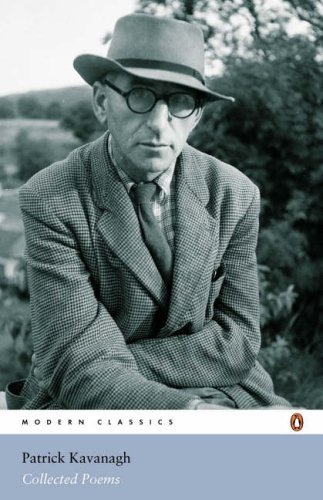
Cover of Patrick Kavanagh's Collected Poems, Published by Penguin
Patrick left school at the age of 13. This in fact would have been quite usual in a rural community. An interest in learning would have been seen as a weakness, young men were needed to be physically strong. The main source of work was manual in nature. Those who had a small farm to work were considered fortunate. The work was heavy and demanding but, for the main, young men found employment as labourers. Intellectual pursuits would have been sneered at. Patrick had not been happy in school. He found it offered no challenge to him and he detested the harshness of the elderly headmistress Julia Cassidy. She had been an old style, severe disciplinarian, who administered corporal punishment daily. Patrick never forgave her for the violation, he felt such treatment to be.
In his final years of his schooling, she was a seriously ill woman. Dying the August of his last year in school. Her place was taken by a series of attractive female teachers. They held a serious fascination for the young man. It was a relief to his parents when he left school in 1918. His official, formal education ending four months before his 14th birthday.
For the next ten years, he spent his time roaming the fields and lanes of his home town. Later in 1929, on publication of his first poem, he remarked on how he had 'squandered the previous ten years'. This was in fact not true, for it was during those days that he assimilated an amazing ability to observe and see extraordinary beauty in even the most mundane everyday things.
Efforts to teach him the skills of shoemaking were not encouraging. He was large and ungainly and never seemed able to embrace the finer points of his father's trade.
At this stage, the family fortunes had increased the family holding to the status of a small farm. His parents planned to settle Patrick on a farm of his own, and to this end he worked at becoming conversant with everything agricultural. He remained, always the dreamer and even when working with other farmers he never overstretched himself physically and was given to day-dreams. The family home had by now been increased in size to better accommodate the large family. A second storey was added, Patrick's room was his haven. There, he developed his new found passion for literature, studying works of poets and reading the meagre selection of books available to him. A period of illness allowed him valuable free time, during which he dabbled in verse. This became his true passion and he was to remark on "How a man can dabble in something, only to find it becomes his life."
He loved the little room, where he developed his craft. One of his early verses was a simple, but yet lovely graphic description of it in his poem. --
My Room
10 by 12
And a low roof
If I stand by the side wall
My head feels the reproof.
Five holy pictures
Hang on the walls -
The Virgin and Child
St. Anthony of Padua
St. Patrick our own
Leo XIII
And The Little Flower.
My bed in the centre
So many things to me -
A dining table,
A writing desk,
A couch,
And a slumber palace.
My room is a musty attic
But its little window
Lets in the stars.
Living in a traditionally Roman Catholic community, Patrick was involved in serving at mass. The rituals and ceremony of the numerous religious events, stirred the awakening aesthetic in the emerging poet. He was to use a religious back-drop to many of his latter, more mature works. He was fortunate in that his experiences with The Church had not been tarnished with any of the dictatorial attitudes so common at that time. His religious fervour was heightened by a deep seated attachment to female role models. In The Virgin he found a well of inspiration.
Patrick Kavanagh, as the young farmer, was unaware of the literary figures of his day. Each region had their own bard, he was viewed as a person to fear. Possessed of ability outside the norm, there was little one could do to inhibit the verses created. Should anyone cause annoyance, the bard could freely vilify his victim in public. When the news of Patrick's first acceptance, for publication of verses he had submitted to a weekly newspaper competition, became known, the only reaction he received was dismay. It was the least likely thing his neighbours had expected, the priest declared he "Had a slate loose".
Encouraged by his new-found literary friend George Russell (AE) he extended his study to include the great classic writers. His breakthrough to the field of letters followed with the publication of three more poems.
He became a frequent visitor to Dublin, where he formed friendships with other young writers, among them, Frank O'Connor.
AE had a reputation for fostering young poets and with his encouragement he found a regular output for his earlier verse in The Dublin Magazine.
He also achieved early success in English journals. His first collection being published in 1936 by Macmillan's of London. This was titled: Ploughman and Other Poems. The most notable of the poetry in this publication was considered to be his poem, Inniskeen Road: July Evening. A sonnet that viewed a road in his home town with both the deep understanding of one who had been steeped in its activities, and the isolation of the poet, who through his art will never really belong with the others who find acceptance among the crowd.
Following the publication of his first volume of poetry, Patrick moved to London to become a full time writer. He had received a commission to write his autobiography. It was there he published The Green Fool to much literary acclaim in English and Dublin circles.
This work appealed to the reviewers as a graphic depiction of Irish Catholic peasant life. Later, Patrick was to denounce the work as one that was not worthy of his skills. He disliked its portrayal of a lifestyle that he felt was only of interest to the masses in its ability to display country folk as a species to be despised. To the sophisticated city dwellers it held the fascination of those who are allowed to look at a past, primate species. Following an action for salnder, following its publication, The Green Fool was withdrawn from circulation.
Through the many hardships of the poet's life, he had one great blessing. His younger brother Peter, was his greatest fan, confidant and source of financial and emotional support. This devotion and unfailing loyalty never faltered throughout the poet's life. Many factors contrived to hamper the poet's progress on his road to recognition. For his own part, he proved to be a rough diamond to the urban intelligentsia. To be fair to him, he possessed an innocence that laid him open to the severe rejection he experienced in Dublin. He was to speak of poets, as those who possessed a heart laid bare. Filled with his passion for poetry, he expected to find in the city a collection of soul-mates who would share joyfully his passion and hunger. Instead he found many who used the arts as a password to the correct circles and had little interest in actually writing poetry.
They held him totally in contempt and treated him with an attitude of disdain. They did not believe an ignorant, small-town farmer could possibly have anything of value to add to the arts. They held him up as a figure of ridicule, another, less dedicated and determined to succeed as a poet, would have shrivelled under their non-acceptance. Patrick's progress was further impeded by events outside his control. His decision to move to Dublin could not have been taken at a worse time.
Ireland as a neutral country played no active part in World War 2, the outbreak of which coincided with his efforts to become a full time writer. One would wonder how such a huge event could reflect on a humble poet, but its effects were a disaster for him. Firstly Macmillan's of London withdrew a promised stipend that would have afforded Patrick a degree of security and financial freedom. The British were not impressed by Ireland's neutrality, and bitterly opposed trading with Her.
War time rationing of paper, limited book printing to a minimum. Certainly, the early writing of an emerging poet would not even be discussed. A second volume of his poems, A Soul For Sale, had been accepted for publication, but the contract was not signed until 1945 and its release did not take place until 1947.
His seeming lack of material did not help to promote his cause. Dogged by misfortune, unable to get a job and living in abject poverty tested the dedication of this amazingly brave artist.
A Soul For Sale displayed the maturing quality of his work. Having left his rural home, his poetry called him back continually to draw on the wealth of insight he had developed in his years of wandering its fields. His acute gift of observation served him well. He wrote of what had been his daily life, with an intensity and candour never previously portrayed.
While he had a certain element of nostalgia in remembering, he was unique in his day for his portrayal of peasant life as it really was. Previous poets had treated rural life in Ireland with the romantic and somewhat patronising air of those who could only imagine country life as one of blissful pastoral contentment. His famous poem Stony Grey Soil depicts his much loved county as a scheming, wily woman. One can feel deeply in its words the duplicity of his emotional attachment to the farm he tried to settle on.
Stony Grey Soil
O stony grey soil of Monaghan
The laugh from my love you thieved;
You took the gay child of my passion
And gave me a clod-conceived.
Later;
You flung a ditch on my vision
Of beauty, love and truth.
O stony grey soil of Monaghan
You burgled my bank of youth!
Finally;
Mullahinsa, Drummeril, Black Shanco -
Wherever I turn I see
In the stony grey soil of Monaghan
Dead loves that were born for me.
One of Patrick's outstanding talents lay in his ability to graphically portray the simplest objects and moments with magnified clarity and beauty. There is not space for many quotes, but I should like to tempt you with a few that I particularly treasure, ie.
Spraying The Potatoes.
The barrels of blue potato-spray
Stood on a headland of July
Beside an orchard wall where roses
Were young girls hanging fom the sky.
In Epic;
That was the year of the Munich bother. Which
Was most important? I inclined
To lose my faith in Ballyrush and Gortin
Till Homer's ghost came whispering to my mind
He said: I made the Illiad from such
A local row. Gods make their own importance.
It is difficult to reduce the life of Patrick Kavanagh to brevity. His personality was both kindly and difficult in the extreme. By many, he was considered an uncouth, unkept and obnoxious character. Always devoted to woman, he was popular with many.
Raglan Road, later set to an old Irish melody, was to gain popularity around the world, and was written following a break up with Dublin girl Hilda Moriarty, with whom he had been besotted.
Unlucky in love, lacking work, poverty stricken to almost starvation point pushed the poet's endurance to the limits. Still Patrick never wavered from his dedication to fulfil his destiny.
He had a strong belief that poets were born not made, his courage in the face of all adversity was almost super-human.
Without looking closer into the layered and complicated life of this poet, it is difficult to fully understand the huge significance of his work at that particular time in Irish literary history.
Previous to his writing, Irish poetry was grounded in Celtic mystical symbolism. The writings were of nationalistic endeavours and romantic portrayals of rustic scenes and contented peasants. They were portrayed as all but inanimate, devoid of the ability to desire more than the meagre existence that was their norm.
Patrick Kavanagh burst like a brilliant meteor on the settled pages of traditional poetry. He wrote from deep inside himself, portraying, naming emotions and desires never validated previously. In tiny details of country life and daily living he painted pictures of great beauty, joy and pathos. To all who read his work, he forces them, with a new sense of pleasure, to look a second time at everything.
He saw objects differently, but, he told facts as they truly were.
His lengthy epic poem, The Great Hunger, shook the established concept of poetic boundaries to their core. It first appeared in 1942 and though highly acclaimed was banned as obscene.
This is a truly magnificent, sad and graphic portrayal of an Irish bachelor farmer. Far from the old portrayal of contented rural peasants, this poem tells of a wasted life filled with a bowed servility to a matriarchal society. The life of its hero Patrick Maguire screamed out the desperation of the small farmer, wedded to the few miserable acres, where he slaved to keep ahead of poverty. Caught in the grip of a religious tradition that demanded he serve God and his neighbour. The poet's references to sexual hungers, and his hero's means of finding release, created an uproar.
This poem marked a turning point in Irish literature, and even today it is a poem that stirs every human emotion and makes the hair literally stand up on the back of one's neck. It is not a poem one can easily forget.
Patrick continued to write. The '50s were the least kind to him. Illness and an over fondness for alcohol made his journey, as always, difficult. He did however have many who recognised his genius. As always, his brother Peter was his constant support and confidant.
He travelled to America and Italy, and his literary services were much in demand during the early 1960s. He published Come Dance With Kitty Stobling, Collected Poems [1964] and Collected Prose.
In 1967 Patrick married Katherine Maloney, sadly he contracted pneumonia and died after a brief illness in a Dublin nursing home on 30th November the same year.
This is just a brief introduction to a poet, who changed the course of Irish Literature. His life holds all the strands and nuances of a fairy-tale where dark and sunshine blend. I thank all those whose work I have dipped into for this article. I ask understanding of those who may feel it does not properly portray the genius and complexity of Patrick Kavanagh. It is not possible to be brief in the face of such a giant's biography.
Bibliography
Works consulted in compilation of this brief Taste of Patrick Kavanagh include -
Patrick Kavanagh; Selected Poems [Penguin Classics]
Patrick Kavanagh, A Biography by Antoinette Quinn
Mary Buckley-Clarke, © Copyright 2005.
| Patrick Kavanagh's Collected Poems at Amazon.com |
This website is designed by booksmusicfilmstv.com.
