|
booksmusicfilmstv.com Home Books Music Films TV Peace & Freedom Press List of Poets Classic Poems
Selected Classic Poems booksmusicfilmstv.com Poets booksmusicfilmstv.com Writers
|
John KeatsFrom Wikipedia, the free encyclopedia
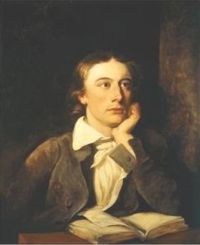
John Keats (31 October 1795 – February 23, 1821) was one of the principal poets of the English Romantic movement. During his short life, his work received constant critical attacks from the periodicals of the day, but his posthumous influence on poets such as Alfred Tennyson has been immense. Elaborate word choice and sensual imagery characterize Keats's poetry, including a series of odes that were his masterpieces and which remain among the most popular poems in English literature. Keats's letters, which expound on his theory of aethestics of "negative capability", were among the most celebrated by any men of letters. LifeJohn Keats was born in 1795 at 85 Moorgate in London, where his father, Thomas Keats, was a hostler. The pub is now called "Keats The Grove," only a few yards from Moorgate station. Keats was baptised at St Botolph-without-Bishopsgate and lived happily for the first seven years of his life. The beginnings of his troubles occurred in 1804, when his father died from a fractured skull after falling from his horse. His mother, Frances Jennings Keats, remarried soon afterwards, but quickly left the new husband and moved herself and her four children (a son had died in infancy) to live with Keats' grandmother. There, Keats attended a school that first instilled in him a love of literature. In 1810, however, his mother died of tuberculosis, leaving him and his siblings in the custody of their grandmother. He soon found his brother, Tom Keats, entrusted to his care. Tom was suffering, as his mother had, from tuberculosis. Finishing his epic poem "Endymion", Keats left to stay and walk in Scotland and Ireland with his friend Charles Brown. However, he too began to show signs of tuberculosis infection on that trip, and returned prematurely. When he did, he found that Tom's condition had deteriorated, and that Endymion had, as had Poems before it, been the target of much abuse from the critics. On 1 December 1818, Tom Keats died from his disease, and John Keats moved again, to live in Brown's house in Hampstead. There he lived next door to Fanny Brawne, where she had been staying with her mother. He then quickly fell in love with Fanny. However, it was overall an unhappy affair for the poet; Keats' ardour for her seemed to bring him more vexation than comfort. The later (posthumous) publication of their correspondence was to scandalise Victorian society. In the diary of Fanny Brawne was found only one sentence regarding the separation: "Mr. Keats has left Hampstead." This relationship was cut short when, by 1820, Keats began showing worse signs of the disease that had plagued his family. On the suggestion of his doctors, he left the cold airs of London behind and moved to Italy with his friend Joseph Severn. Keats moved into a house on the Spanish Steps, in Rome, where despite attentive care from Severn and Dr. John Clark, the poet's health rapidly deteriorated. He died in 1821 and was buried in the Protestant Cemetery, Rome. His last request was followed, and thus he was buried under a tomb stone reading, "Here lies one whose name was writ in water." His name does not appear on the stone. Shelley and Byron erroneously blamed his death on an article published shortly before in the Quarterly Review, with a scathing attack on Keats's Endymion; "snuffed out by an article" was Byron's phrase. The offending article was long believed to have been written by William Gifford, though later shown to be the work of John Wilson Croker. Keats' death inspired Shelley to write the poem Adonais. Career and criticismHis introduction to the work of Edmund Spenser, particularly The Faerie Queene, was to prove a turning point in Keats' development as a poet; it was to inspire Keats to write his first poem, Imitation of Spenser. He befriended Leigh Hunt, a poet and editor who published his first poem in 1816. In 1817, Keats published his first volume of poetry entitled simply Poems. Keats' Poems was not well received, largely due to his connection with the controversial Hunt. Keats produced some of his finest poetry during the spring and summer of 1819; in fact, the period from September 1818 to September 1819 is often referred to among Keats scholars as the Great Year, or the Living Year, because it was during this period that he was most productive and that he wrote his most critically acclaimed works. Several major events have been noted as factors in this increased productivity: namely, the death of his brother Tom, the critical reviews of Endymion, and his meeting of Fanny Brawne. The famous odes he produced during the spring and summer of 1819 include: Ode to Psyche, Ode on a Grecian Urn, Ode to a Nightingale, Ode on Melancholy, and To Autumn. Keats developed his poetic theories, chief among them Negative Capability and The Mansion of Many Apartments, in letters to friends and family. In particular, he stated he wished to be a "chameleon poet" and to resist the "egotistical sublime" of Wordsworth's writing. Oscar Wilde, the aestheticist non pareil was to later write: "[...] who but the supreme and perfect artist could have got from a mere colour a motive so full of marvel: and now I am half enamoured of the paper that touched his hand, and the ink that did his bidding, grown fond of the sweet comeliness of his charactery, for since my childhood I have loved none better than your marvellous kinsman, that godlike boy, the real Adonis of our age[...] In my heaven he walks eternally with Shakespeare and the Greeks." William Butler Yeats was intrigued by the contrast between the "deliberate happiness" of Keats's poetry and the sadness that characterised his life. He wrote in Ego Dominus Tuus (1915):
Wallace Stevens described Keats as the "Secretary for Porcelain" in Extracts from Addresses to the Academy of Fine Ideas.
Lord Byron wrote (in a parody of the nursery rhyme 'Who killed Cock Robin?') on Keats' death in 1821:
Popular ReferencesRetrieved from "http://en.wikipedia.org/wiki/John_Keats" All text is available under the terms of the GNU Free Documentation License (see Copyrights for details). |