|
booksmusicfilmstv.com
Home Books Music Films TV Peace & Freedom Press List of Poets Classic Poems

|
TO FLUSH, MY DOG
By Elizabeth Barrett Browning (1806-1861)
|
Yet, my pretty sportive friend,
Little is't to such an end
That I praise thy rareness!
Other dogs may be thy peers
Haply in these drooping ears,
And this glossy fairness.
But of thee it shall be said,
This dog watched beside a bed
Day and night unweary
Watched within a curtained room,
Where no sunbeam brake the gloom
Round the sick and dreary.
Roses, gathered for a vase,
In that chamber died apace,
Beam and breeze resigning.
This dog only, waited on,
Knowing that when light is gone
Love remains for shining.
Other dogs in thymy dew
Tracked the hares, and followed through
Sunny moor or meadow.
This dog only, crept and crept
Next a languid cheek that slept,
Sharing in the shadow.
Other dogs of loyal cheer
Bounded at the whistle clear,
Up the woodside hieing.
This dog only, watched in reach
Of a faintly uttered speech,
Or a louder sighing.
And if one or two quick tears
Dropped upon his glossy ears,
Or a sigh came double
Up he sprang in eager haste,
Fawning, fondling, breathing fast,
In a tender trouble.
And this dog was satisfied
If a pale thin hand would glide
Down his dewlaps sloping
Which he pushed his nose within,
After-platforming his chin
On the palm left open. |

Selected Classic Poems
Matthew Arnold - Dover Beach
William Blake - The Tiger
Rupert Brooke - The Soldier
Elizabeth Barrett Browning - To Flush, My Dog
Robert Burns - A Red, Red Rose
Lewis Carroll - Jabberwocky
Samuel Taylor Coleridge - The Dungeon
Emily Dickinson - The Pedigree Of Honey
Ralph Waldo Emerson - Ode To Beauty
Gerard Manley Hopkins - The Caged Skylark
John Keats - The Human Seasons
The Rubaiyat Of Omar Khayyam
Rudyard Kipling - If
Edward Lear - The Owl And The Pussy Cat
Henry Wadsworth Longfellow - The Song Of Hiawatha: Part 1, Chapter 1
Wilfred Owen - Anthem For Doomed Youth
Christina Rossetti - Remember
Percy Bysshe Shelley - To A Skylark
Walt Whitman - A Noiseless Patient Spider
William Wordsworth - Daffodils
booksmusicfilmstv.com Poets
Mary Buckley-Clarke
Barbara Carpenter
Francesca Heaney
Phil Knight
Dorothy Koenigsberger
Joanna Lilley
Sylvia Maclagan
Daf Richards
Ingrid Riley
Charley Shaw
Judy Stubley
Gwynn Watt
Carol Wolrich
booksmusicfilmstv.com Writers
Cardinal Cox
Anthony James
Nigel Pretentious
|
Elizabeth Barrett Browning

Selected Poems (available at Amazon UK) ~ Elizabeth Barrett Browning
From Wikipedia, the free encyclopedia
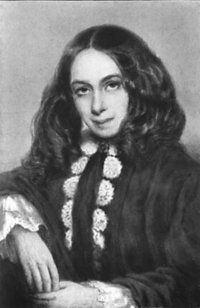
Elizabeth Barrett Browning (March 6, 1806 – June 29, 1861) was a member of the Barrett family and one of the most respected poets of the Victorian era.
Biography
Elizabeth spent her youth at Hope End in 1809, near Great Malvern. While still a child she had a considerate fortune from the Jamaican Sugar Plantations due to her father (Edward Moulton) who published 50 copies of a juvenile epic, on the Battle of Marathon. She was educated at home, but owed her profound knowledge of the Greek language and much mental stimulus to her early friendship with the blind scholar, Hugh Stuart Boyd, who was a neighbor.
In her early teens, Elizabeth contracted a lung complaint, possibly tuberculosis, although the exact nature has been the subject of much speculation, and was treated as a permanent invalid by her parents. For a girl of that time, she was well-educated, having been allowed to attend lessons with her brother's tutor. She published her first poem, anonymously, at the age of fourteen, but wrote her first at the age of twelve. In 1826 she published anonymously An Essay on Mind and Other Poems.
Shortly afterwards, the abolition of slavery, a cause which she supported (see her work The Runaway Slave at Pilgrim's Point (1849)), considerably reduced Mr. Barrett's means. He accordingly disposed of his estate and moved with his family first to Sidmouth and afterwards to London. At the former location Miss Barrett wrote Prometheus Bound (1833). After her move to London she fell into delicate health, her lungs being threatened. This did not, however, interfere with her literary labours, and she contributed to various periodicals "The Romaunt of Margaret", "The Romaunt of the Page", "The Poet's Vow", and other pieces. In 1838 appeared The Seraphim and Other Poems (including "Cowper's Grave").
Shortly thereafter, the death of her favorite brother gave a serious shock to her already fragile health; and for a time she hovered between life and death. Eventually, however, she regained strength, and meanwhile her fame was growing. The publishing about 1841 of "The Cry of the Children" gave it a great impulse, and about the same time she contributed some critical papers in prose to Richard Henry Horne's New Spirit of the Age. In 1844 she published two volumes of Poems, which comprised "The Drama of Exile", "Vision of Poets", and "Lady Geraldine's Courtship".
In 1845 she met for the first time her future husband, Robert Browning. Their courtship and marriage, owing to her delicate health and the extraordinary objections entertained by Mr. Barrett to the marriage of any of his children, were carried out under somewhat peculiar and romantic circumstances. After a private marriage at St Marylebone Parish Church and a secret departure from her home, she accompanied her husband to the Italian Peninsula, which became her home almost continuously until her death, and with the political aspirations of which she and her husband both thoroughly identified themselves.
The union proved one of unalloyed happiness to both, though it was never forgiven by Mr. Barrett. In her new circumstances her strength greatly increased, and she gave birth to a son, Robert Wiedemann Barrett Browning, called "Pen," at the age of 43. The Brownings settled in Florence, and there she wrote Casa Guidi Windows (1851)—by many considered her strongest work—under the inspiration of the Tuscan struggle for liberty. In Florence she became close friend of British-born poets Isabella Blagden and Theodosia Trollope Garrow.
Aurora Leigh, her largest, and perhaps the most popular of her longer poems, appeared in 1856. In 1850 The Sonnets from the Portuguese—the history of her own love-story, thinly disguised by its title (Robert Browning called Elizabeth Barrett "[his] Portuguese" as a pet name because of her complexion.)—had appeared. In 1860 she issued a collected edition of her poems under the title, Poems before Congress which were political poems. Soon thereafter her health underwent a change for the worse; she gradually lost strength, and died on June 29, 1861. She is buried in Florence in the English Cemetery, Florence.
Mrs. Browning was a woman of singular nobility and charm, and though not beautiful, was remarkably attractive. Mary Russell Mitford thus describes her as a young woman: "A slight, delicate figure, with a shower of dark curls falling on each side of a most expressive face; large, tender eyes, richly fringed by dark eyelashes, and a smile like a sunbeam." Anne Thackeray Ritchie described her as: "Very small and brown" with big, exotic eyes and an overgenerous mouth.
Literary significance
Browning is generally considered the greatest of English poetesses. Her works are full of tender and delicate, but also of strong and deep, thought. Her own sufferings, combined with her moral and intellectual strength, made her the champion of the suffering and oppressed wherever she found them. Her gift was essentially lyrical, though much of her work was not so in form. Her weak points are the lack of compression, an occasional somewhat obtrusive mannerism, and frequent failure both in metre and rhyme.
Her most famous work is Sonnets from the Portuguese, a collection of love sonnets written by Browning but disguised as a translation. By far the most famous poem from this collection, with one of the most famous opening lines in the English language, is number 43:
- How do I love thee? Let me count the ways.
- I love thee to the depth and breadth and height
- My soul can reach, when feeling out of sight
- For the ends of Being and ideal Grace.
- I love thee to the level of everyday's
- Most quiet need, by sun and candle-light.
- I love thee freely, as men strive for Right;
- I love thee purely, as they turn from Praise.
- I love thee with the passion put to use
- In my old griefs, and with my childhood's faith.
- I love thee with a love I seemed to lose
- With my lost saints!---I love thee with the breath,
- Smiles, tears, of all my life!---and, if God choose,
- I shall but love thee better after death.
But while her Petrarchan Sonnets from the Portughese are exquisite, she was also a prophetic, indeed epic, poet, writing Casa Guidi Windows in support of Italy's Risorgimento, as had Byron supported Greece's liberation from Turkey, and writing Aurora Leigh, in nine books, the woman's number, following the death of Margaret Fuller by drowning in the ship 'Elizabeth', in which Aurora mirrors Margaret and Marian Erle, herself. She sets Aurora Leigh in Florence, England and Paris, using in it her knowledge from childhood of the Bible in Hebrew, Homer, Aeschylus, Sophocles, Apuleius, Dante, Langland, Madame de Stael, and George Sand.
The government of Italy and the Commune of Florence celebrated her poetry with commemorative plaques on Casa Guidi, where the Brownings had lived during their 15 year marriage. Lord Leighton designed her tomb in the English Cemetery, its sculpting in Carrara marble being carried out, not faithfully, by Francesco Giovannozzo. In 2006 the Comune of Florence laid a laurel wreath on this tomb to mark 200 years since her birth.
See also
Karlin, Daniel. The courtship of Robert Browning and Elizabeth Barrett. (Oxford, 1985) (Critical biography focused on the courtship correspondence.)
Kelley, Philip et al. (Eds.) The Brownings' correspondence. 15 vols. to date. (Wedgestone, 1984-) (Complete letters of Elizabeth Barrett Browning and Robert Browning, so far to 1849.)
Garrett, Martin (Ed.) Elizabeth Barrett Browning and Robert Browning: Interviews and Recollections (Basingstoke and London, 2000). (Accounts of both poets by themselves and others.)
Garrett, Martin, Elizabeth Barrett Browning and Robert Browning (London, 2001). (Biography and discussion of the poetry.)
Woolf, Virginia. Flush: A Biography (Biographical novella written from the perspective of Elizabeth Barrett Browning's dog, principally of curiosity value.)
External links
Wikimedia Commons has media related to:
Wikiquote has a collection of quotations related to:
Wikisource has original works written by or about:
Wikisource has an original article from the 1911 Encyclopædia Britannica about:
Retrieved from "Elizabeth_Barrett_Browning"
All text is available under the terms of the GNU Free Documentation License (see Copyrights for details).
Privacy policy
|