|
booksmusicfilmstv.com Home Books Music Films TV Peace & Freedom Press List of Poets Classic Poems
Selected Classic Poems booksmusicfilmstv.com Poets booksmusicfilmstv.com Writers
|
Rupert BrookeFrom Wikipedia, the free encyclopedia
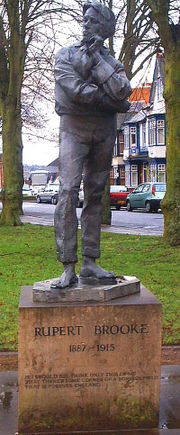
Rupert Chawner Brooke (August 3, 1887 – April 23, 1915) was an English poet known for his idealistic War Sonnets written during the First World War (especially The Soldier), as well as for his poetry written outside of war, especially The Old Vicarage, Grantchester and The Great Lover. He was also known for his boyish good looks, which prompted W. B. Yeats to describe him as "the handsomest young man in England". BiographyBrooke was born at 5 Hillmorton Road in Rugby, Warwickshire, England, the son of a William Parker Brooke, a Rugby schoolmaster and Ruth Mary Brooke née Cotterill. He attended Hillbrow Prep School before being educated at Rugby School. While travelling in Europe, he prepared a thesis entitled "John Webster and the Elizabethan Drama", which won him a scholarship to King's College, Cambridge, where he became a member of the Cambridge Apostles, helped found the Marlowe Society drama club and acted in plays. Brooke made friends among the Bloomsbury group of writers, some of whom admired his talent, while others were more impressed by his good looks. Brooke belonged to another literary group known as the Georgian Poets, and was the most important of the Dymock poets, associated with the Gloucestershire village of Dymock, where he spent some time before the war. He also lived in the Old Vicarage, Grantchester (a house now occupied by Jeffrey Archer and his wife Mary Archer). Brooke toured the United States and Canada to write travel diaries for the Westminster Gazette and visited several islands in the South Seas. It was later revealed that he may have fathered a daughter with a Tahitian woman (Taatamata) with whom he seems to have enjoyed his most complete emotional relationship. He was also romantically involved with the actress Cathleen Nesbitt. Brooke was once engaged to Noel Olivier, whom he met while she was a 15-year-old at the progressive Bedales School. His accomplished poetry gained many enthusiasts and followers and he was taken up by Edward Marsh, who brought him to the attention of Winston Churchill, then First Lord of the Admiralty. He was commissioned into the Navy shortly after his 27th birthday and took part in the Royal Naval Division's Antwerp expedition in October 1914. He sailed with the British Mediterranean Expeditionary Force on February 28, 1915 but developed septic pneumonia from an infected mosquito bite. He died at 4.20pm on April 23, 1915 off the island of Lemnos in the Aegean on his way to a battle at Gallipoli. As the expeditionary force had orders to depart immediately, he was buried at 11pm in an olive grove on the island of Skyros, Greece. His grave remains there today. As a side-note, Rupert Brooke's brother, 2nd Lt. William Alfred Cotterill Brooke was a member of the 8th Battalion London Regiment (Post Office Rifles) and was killed in action near Le Rutoire Farm on the historic Loos battlefield on June 14, 1915, aged 24. He is buried in Fosse 7 Military Cemetery (Quality Street), Mazingarbe, Pas de Calais, France. He had only joined the battalion on May 25. References
External linksWikisource has original works written by or about:
Retrieved from "http://en.wikipedia.org/wiki/Rupert_Brooke" All text is available under the terms of the GNU Free Documentation License (see Copyrights for details). |