|
booksmusicfilmstv.com Home Books Music Films TV Peace & Freedom Press List of Poets Classic Poems
Selected Classic Poems booksmusicfilmstv.com Poets booksmusicfilmstv.com Writers
|
Emily DickinsonFrom Wikipedia, the free encyclopedia
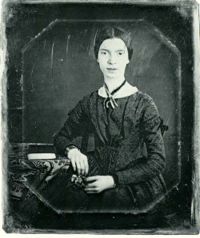
Emily Dickinson (December 10, 1830 – May 15, 1886 (aged 55)) was an American poet. Though virtually unknown in her lifetime, Dickinson has come to be regarded, along with Walt Whitman, as one of the two quintessential American poets of the 19th century. Dickinson lived an introverted and hermetic life. Although she wrote, at the last count, 1,789 poems, only a handful of them were published during her lifetime. All of these were published anonymously and some may have been published without her knowledge. BiographyEmily Elizabeth Dickinson was born on December 10, 1830, and lived almost all of her life in her family's houses in Amherst, which has been preserved as the Emily Dickinson Museum. In 1840, Emily was educated at the nearby Amherst Academy, a former boys' school which had opened to female students just two years earlier. She studied English and classical literature, learning Latin and reading the Aeneid over several years, and was taught in other subjects including religion, history, mathematics, geology, and biology. In 1847, at 17, Dickinson began attending Mary Lyon's Mount Holyoke Female Seminary (which would later become Mount Holyoke College) in South Hadley. Austin Dickinson, her brother, was sent to bring her home after less than a year at the Seminary, and she did not return to the school. Some speculate that she was homesick, however there is also speculation that she refused to sign an oath stating she would devote her life to Jesus Christ, and realizing she no longer wanted to attend there, went home and never returned. After that, she left home only for short trips to visit relatives in Boston, Cambridge, and Connecticut. For decades, popular wisdom portrayed Dickinson as an agoraphobic recluse. New scholarship suggests that while she was not necessarily an overly sociable person, she certainly valued her friends. Dickinson's brother Austin married Susan Gilbert in 1856; Susan and Emily had known each other earlier. Emily asked Susan to critique her poems, at which she began working harder than ever. Dickinson later died on May 15, 1886. The cause of death was listed as Bright's disease (nephritis). After her death, her family found 40 hand-bound volumes containing more than 1,700 of her poems. Family BackgroundDickinson's father, Edward Dickinson (1803–1879), was politically prominent, serving on the Massachusetts General Court from 1838 to 1842, the Massachusetts Senate from 1842 to 1843, and the U.S. House of Representatives (to which he was elected as a Whig candidate in 1852). Her mother, Emily Norcross Dickinson (1804–1882), a quiet woman, was chronically ill. William Austin Dickinson (1829–1895), usually known by his middle name, was her older brother. He later married Dickinson's most intimate friend, Susan Gilbert, in 1856, and made his home next door to the house in which Emily lived most of her life. Their younger sister, Lavinia Norcross Dickinson (1833–1899), often known as "Vinnie", encouraged the posthumous editing and publishing of her sister's poetry. Emily Dickinson's posthumous popularity at the turn of the century may have inspired one of her aunts, Kate Dickinson Sweetser, to become a writer. Poetry and InfluenceHer poetry is often recognizable at a glance. Her facility with ballad and hymn meter, her extensive use of dashes and unconventional capitalization in her manuscripts, and her idiosyncratic vocabulary and imagery combine to create a unique lyric style. Although over half of her poems were written during the years of the American Civil War, it bears no overt influence in her poetry. Dickinson toyed briefly with the idea of having her life in her poems published, even asking Thomas Wentworth Higginson, a literary critic, for advice. Higginson immediately realized the poet's talent, but when he tried to "improve" Dickinson's poems, adapting them to the more florid, romantic style popular at the time, Dickinson quickly lost interest in the project. By her death (1886), only ten of Dickinson's poems (see: Franklin Edition of the Poems, 1998, App. 1) had been published. Seven of those ten were published in the Springfield Republican. Three posthumous collections in the 1890s established her as a powerful eccentric, but it wasn't until the twentieth century that she was appreciated as a poet. Dickinson's poetry was collected after her death by Higginson and Mabel Loomis Todd, with Todd initially collecting and organizing the material and Higginson editing. They edited the poems extensively in order to regularize the manuscripts' punctuation and capitalization to late nineteenth-century standards, occasionally rewording poems to reduce Dickinson's obliquity. A volume of Dickinson's Poems was published in Boston in 1890, and became quite popular; by the end of 1892 eleven editions had sold. Poems: Second Series was published in 1891 and ran to five editions by 1893; a third series was published in 1896. Two volumes of Dickinson's letters, heavily edited and selected by Todd (who falsified dates on some of them), were published in 1894. This wave of posthumous publications gave Dickinson's poetry its first real public exposure, and it found an immediate audience. Backed by Higginson and William Dean Howells with favorable notices and reviews, the poetry was popular from 1890 to 1892. Later in the decade, critical opinion became negative. Thomas Bailey Aldrich published an influential negative review anonymously in the January 1892 Atlantic Monthly:
In the early 20th century, Dickinson's niece, Martha Dickinson Bianchi, published a series of further collections, including many previously unpublished poems, with similarly normalized punctuation and capitalization; The Single Hound emerged in 1914, The Life and Letters of Emily Dickinson and The Complete Poems of Emily Dickinson in 1924, Further Poems of Emily Dickinson in 1929. Other volumes edited by Todd and Bianchi emerged through the 1930s, releasing gradually more previously unpublished poems. With the rise of modernist poetry, Dickinson's failure to conform to nineteenth-century ideas of poetic form was no longer surprising nor distasteful to new generations of readers. A new wave of feminism created greater cultural sympathy for her as a female poet. Her stock had clearly risen, but Dickinson was not generally thought a great poet among the first generation of modernists, as is clear from R.P. Blackmur's critical essay of 1937:
The texts of these early editions would hardly be recognized by later readers, as their extensive editing had altered the texts found in Dickinson's manuscripts substantially. A new and complete edition of Dickinson's poetry by Thomas H. Johnson, The Poems of Emily Dickinson, was published in three volumes in 1955. This edition formed the basis of all later Dickinson scholarship, and provided the Dickinson known to readers thereafter: the poems were untitled, only numbered in an approximate chronological sequence, were strewn with dashes and irregularly capitalized, and were often extremely elliptical in their language. They were printed for the first time much more nearly as Dickinson had left them, in versions approximating the text in her manuscripts. A later variorum edition provided many alternate wordings from which Johnson, in a more limited editorial intervention, had been forced to choose for the sake of readability. Later readers would draw attention to the remaining problems in reading even Johnson's relatively unaltered typeset texts of Dickinson, claiming that Dickinson's treatment of her manuscripts suggested that their physical and graphic properties were important to the reading of her poems. Possibly meaningful distinctions could be drawn, they argued, among different lengths and angles of dash in the poems, and different arrangements of text on the page. Several volumes have attempted to render Dickinson's handwritten dashes using many typographic symbols of varying length and angle; even R.W. Franklin's 1998 variorum edition of the poems, which aimed to supplant Johnson's edition as the scholarly standard text, used typeset dashes of varying length to approximate the manuscripts' dashes more closely. Some scholars claimed that the poems should be studied by reading the manuscripts themselves. MusicBecause of her frequent use of common metre, many of Dickinson's poems can easily be set to tunes (for example "I heard a fly buzz when I died- / The Stillness in the Room / Was like the Stillness in the Air / Between the Heaves of Storm"). Dickinson’s poetry has been used as texts for art songs by composers such as Aaron Copland, and Nick Peros. Because of this, one can also sing many of her poems to the tunes of "Amazing Grace", "The Yellow Rose of Texas", or the "Gilligan's Island" theme song. While this novelty is entertaining in itself, it also demonstrates the connection between poetry and song embodied for centuries in the ballad. SexualityThe sexuality of Emily Dickinson is a topic of dispute; it has been argued that she may have been bisexual or lesbian. Dickinson's possible romantic and sexual adventures are matters of great controversy among her biographers and critics. There is little evidence on which to base a conclusion about the objects of her affection, though Dickinson's understanding of passion can be inferred through some of her poems and letters. Attention has focused especially on a group of letters addressed only to "Master", known as the Master letters, in which Dickinson appears to be writing to a male lover; neither the addressee of these letters, nor whether they were sent, has been established. Some biographers have been convinced Dickinson might have been romantically involved with the newspaper publisher Samuel Bowles, a friend of her father's, Judge Otis Lord, or a minister named Charles Wadsworth. A relatively recent theory has emerged that proposes William S. Clark, a prominent figure in Amherst at the time, as the identity of her "Master". Some biographers have theorized Dickinson may have had romantic attachments to women in her younger years, a hypothesis which has grown in popularity. After a claimed romance with Emily Fowler, circa 1850, some conjecture that Susan Gilbert 1851, her closest friend and sister-in-law, was another possible love. The evidence for all these theories is circumstantial at best. Many scholars that claim the evidence for the latter theory about her relationship with women is scant and highly ambiguous. Peggy Macintosh, from Wellesley College's Center for Research on Women, and Ellen Louise Hart, from University of California at Santa Cruz: Cowell College, in their introduction of Emily Dickinson in The Heath Anthology of American Literature (Fifth Edition) note that "It is important to understand the role in Dickinson studies played by homophobia.... We do not know to what extent Dickinson expressed her sexual desires physically...." Whether Dickinson had romantic feelings for women or not, it is important to remember that her poetry was heavily edited by several people before being released into the public posthumously. According to Macintosh and Hart, there is evidence that Mabel Loomis Todd (the editor) was Austin Dickinson's mistress, and together they "mutilated Dickinson’s manuscripts, erasing [Susan's] name and scissoring out references to her." There were lines of poems that were completely scratched out. Todd was involved in the editing of all three initial volumes of Emily's published works. This alteration of documents throws possible romantic aspects into ambiguity. Other aspects, though, such as their lifelong friendship (late teens to Emily's death), are not ambiguous. It is well-known that no one received more writing from Emily than Susan Gilbert. There were hundreds of letters found, which Gilbert reciprocated. Dickinson's few friendships were all very close, and her friendship with Gilbert was no exception. Some of the letters were very passionate, furthering this ambiguity. While many of Dickinson's letters and poems are highly charged, passionate, and erotic, few biographers or critics believe that Dickinson physically consummated a relationship with anyone. References
External linksWikiquote has a collection of quotations related to:
Wikisource has original works written by or about:
Wikimedia Commons has media related to:
Retrieved from "http://en.wikipedia.org/wiki/Emily_Dickinson" All text is available under the terms of the GNU Free Documentation License (see Copyrights for details). |
||||||||||||||||||